Tag: stucco
Stucco Series – Prep Work Required
by admin on Jul.09, 2011, under Favorites, Images, Real Estate
Now that the wall is more secure and level and some final color preferences have been decided, it’s time to figure how to get a wet and somewhat drippy concrete/stucco mixture to adhere to an upright wall. This info also applies for anyone wishing to update their home’s exterior with a manufactured stone veneer. I’ve put a great resource for this product in a prior post.
The first layer is a sticky ice and water shield. This keeps water from crevices around windows and doors and keeps it flowing down and away from potential fill spaces. Some people apparently prefer to skip this step and handle any crevices later with a silicone caulk. Here’s a link to one particular ice and water product – shown being applied to a roof.
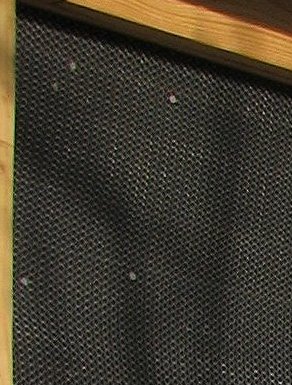
Next is waterproof, 2-ply tar paper which provides the moisture barrier to the plywood beneath. It is simply stapled in place, working from the bottom up, and making sure to allow enough to overlay, (4″ is recommended) from section to section for full coverage. Wrap paper securely around corners.
Third is metal lath. This stuff is a pain to cut and it isn’t cheap, but if applied as evenly as possible over your tar paper, this is the key to making your stucco mixture adhere to your walls. I can’t emphasize enough how important it is to keep your lath product as even and as flush as possible – particularly at corner seams. I’m not getting into specific prices here because they vary considerably from state to state and certainly from country to country.
In the US, Lowe’s is always a good place to start and there are plenty of online resources when it’s time to get down to calculating how much material you need, etc. Here are some links I found useful.
Stucco – some basic FAQ and answers
From Quikrete – My new best friend!
Fiberglass vs metal lath – go green!
Next: Now that the destination site is prepared, stucco tools and toys you’ll need.
Stucco Series – Design and Color Questions
by admin on Jul.07, 2011, under Favorites, Images, Real Estate
There has been a lot of time spent studying stucco over the last 6 months. Who knew that making the choice to use stucco to replace exterior siding would prompt so many design decisions.
I knew I wanted a English cottage appearance but since my name isn’t Hansel or Gretel and I’m not likely to do a thatched roof, I didn’t want this:
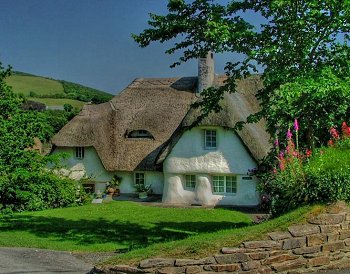
Quaint as it is, it isn’t really my style.
On the other hand, many stuccoed houses I saw ended up looking like commercial buildings or survival bunkers. What I wanted from stucco was a nice clean line and a little interesting texture – along with the added insulation from weather and noise.
I began studying what is known as “Cotswold” style. Close, but no cigar!
This style – along with its sister style Tudor, does not really go well with my one level house. Tudor looks great on large homes and commercial structures. Here is a photo I took of the Hotel Roanoke in Virginia. It is an impressive building, but all this trim color will make my little 1600 square-foot cottage look a little choppy and I will have trim to consider.

Hotel Roanoke, Virginia
I found the website Ontario Architecture which gave me some really good design ideas and an image fairly close to what I wanted.
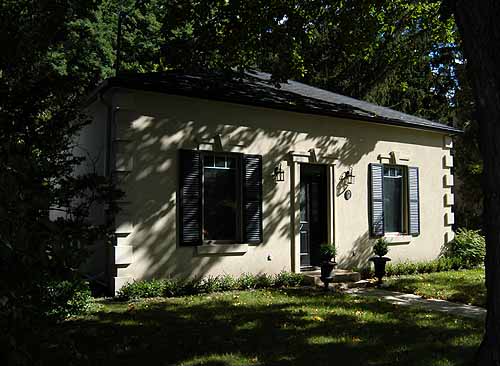
Clean lines, some nice opportunities for architectural design elements, and a natural-look color.
Color? Oh no. What about color? How do you get it, or not?
Back to The Mold Store I went since I’d already purchased powdered colorant for my paver stones. They had quite a few colors, but for my stuccoed walls I want a pearly-gray/white color. Early samples made from the very first stucco mix had the outcome a little too much brown tone for my taste.
Much of this color issue has to do with the sand portion of the stucco mix. Sand comes in a huge variety of shades and it all is certainly not white! Cement has less variety but from what I gather, true, Portland cement is the cleanest and brightest to work with.
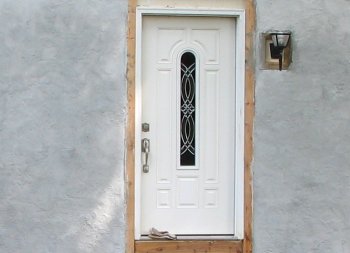
Many people do not worry about the base stucco since they plan on painting it. I’m trying to avoid this step. This is not an adobe home with the standard southwestern colors and I really don’t want to have to paint this house after all this work.
A little further research found a whiter sand available nearby and the addition of white powder colorant to the finish mix got the stucco within the color range desired. This was still a little damp when the picture was taken.
Now, that it appeared the color was do-able, and I’m beginning to find ways to make a specific texture on the surface, how the heck do you make this stuff stay on the wall? That’s a story for another day…